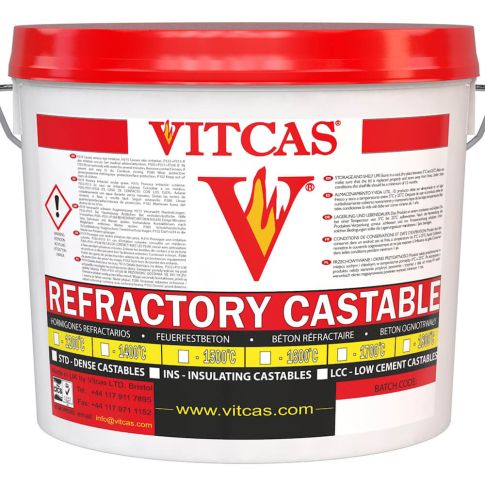
Refractory concrete, referred to in English as refractory castable, is used for making or restoring specific elements of the lining. It does not serve the same purpose as a thin repair cement joint. Durability depends on the selection of the mix, support, and proper drying before heating.
When to consider concrete instead of cement?
When repairing, it is necessary to determine whether you are restoring a spatial element or a layer of lining, or just a small defect. Important factors include geometry, thickness, temperature, fuel, and wear conditions. Concrete is not an automatic choice for every type of damage.
Refractory concrete Vitcas class 1600 is an example of a specific mix. The temperature value in the name does not determine its suitability for every boiler. BLACK Fire Cement is another type of material: a ready-mixed mass for small repairs and suitable thin joints.
What to check in damaged lining?
Examine the support, fastenings, and condition of adjacent parts. Note whether the element crumbles locally or the entire layer moves. In a boiler, a service assessment may also be needed for structures that are not visible from the chamber side.
Before mixing, plan the form, the amount of material, and the order of placement. You must know the recommended amount of water and the working time after preparation. Adding more water for convenience may change the properties of the mixture. Do not randomly combine different mixes or fresh material with a portion that has exceeded its working time.
Curing and drying are part of the repair
Maintain the curing conditions specified for the particular mix. Then apply the prescribed drying procedure and initial heating. The amount of moisture and the thickness of the component affect the requirements; a single general schedule does not fit all repairs.
Sudden thermal load on a damp lining can damage it. Do not treat a surface that feels dry as proof of the entire element being ready. Before restoring normal operation, inspect the repair and compliance with the equipment requirements. Recurring wear requires checking the cause of the wear, not just another batch of concrete.